
When businesses find a cloud Consulting partner, they expect the cloud Consulting partner to handle cloud infrastructure costs, reduce unnecessary cloud resource usage and spending, and establish better application security, reliability, and stability of the business product. Choosing a desired cloud Consulting partner is not simply hiring an IT vendor based on their portfolio. If you hire the wrong cloud consultant, it may impact your cloud budget; there can be security issues they did not handle well.
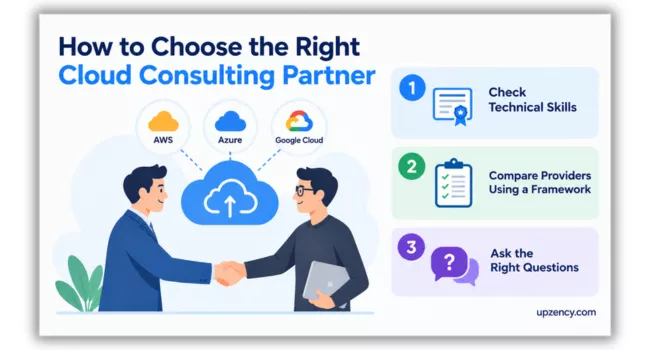
1. Validate Technical Breadth vs. Workload Specialization
Most organisations are looking for specialised cloud expertise that can handle complex migration tasks efficiently rather than a general cloud service firm
Hyperscaler Credentials:
Before hiring cloud teams, a business must make sure if there cloud team holds professional certificates from major cloud providers such as AWS, Microsoft Azure, Google Cloud, and others instead of some basic relevant certification.
Domain Mastery:
You also need to evaluate the cloud tech team's domain knowledge based on your expectations. Let's say your project requirement is to re-architect a monolithic database into a cloud-native environment; then there is a dedicated cloud database specialist out there as well who may not be very experienced in orchestrating Kubernetes or deploying infrastructure as Code theerfore choose a team that can demonstrate relevant experience matching with yout applications tasks.
2. Compare Providers Using an Evaluation Framework
Before scheduling A Discovery call with any cloud Service Provider, evaluate the below important criteria to assess a cloud consulting firm:
| Evaluation Pillar | Green Flag (Practitioner Signals) | Red Flag (Surface-Level Signals) |
|---|---|---|
| Technical Depth & EEAT | Ensure the technical team has advanced hyperscaler certifications with target workload | Advertises expertise on cloud platforms without verifiable certifications or credentials. |
| FinOps & Cost Governance | Planning to implement FinOps practices from Day 1, including cost tagging, budget alerts, and other cloud resource optimization steps | Leave crucial cost optimizations and related optimization tasks for a later phase. |
| Security & DevSecOps | Able to provide evidence about zero-trust architecture experience across relevant framework such as SOC 2 Type II, PCI DSS and others. | Depends on cloukld provider’s default configutrauons settings instead of implementing workload IAM controls. |
| Knowledge Handoff | Uses a collaborative engineering model that includes technical documentation practical CI/CD knowledge transfer. | Relies on opaque custom script without better technical handover documentation or clear functional visibility. |
3. Ask Operational Questions
Before any discovery meeting with any cloud partner, Business should list the questions before which you should you must check with them about their experience, approach, and other criteria as below
- Relevant Experience: Have you worked on a task similar to our requirement before? If yes, can you share some of your experience and approach, and what were the challenges you faced and how you handled them?
- Cost Management: What is your approach to identifying unused and unnecessary resources for cost-saving opportunities?
- Security: What methodology do you follow to meet security guidelines and monitor security vulnerabilities?
- Project Team: Check who will actually be involved in your project after the kick-off meeting. Ask them to check who will be the primary point of contact (POC) for any discussions, participants, and the level of technical personnel going to work on your project.
- Documentation & Training: Ask them about the knowledge transfer process after implementation. Do you provide well-defined technical documentation and training material as part of project handover?