
Introduction
We live in an ever-evolving digital age where the traditional way of creating new software is not in sync with all the things around us changing – new requirements, changes in the market, and also changes in what customers expect from us.
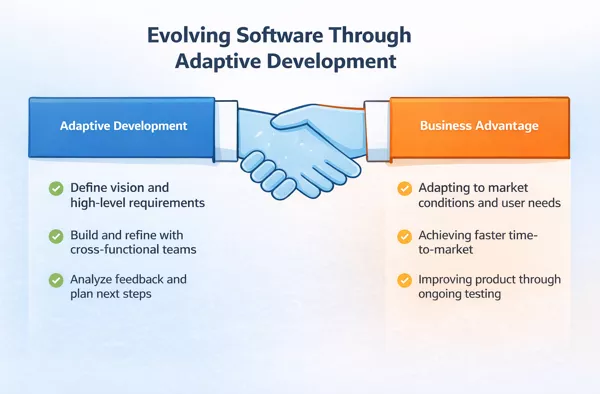
We rarely see projects completed as they were initiated – there are lots of changes and disruptions. Sometimes requirements will be changed, either because you can’t use them anymore or because something new has entered the market, and often times the priority of what you do will be changed based on customer feedback.
To continuously evolve software products and not have them break, we need to embrace adaptive software development (ASD).
In this document, you will find a complete overview of:
- The definition of adaptive software development
- The way the adaptive software development model works
- The benefits and limitations of adaptive software development
- Comparison of adaptive software development with waterfall and agile models of development
- How and when to use adaptive software development
- Identifying the ideal partner for adaptive software development
What Is Adaptive Software Development?
Adaptive Software Development (ASD) is a methodology developed by Jim Highsmith and Sam Bayer during the early evolution of agile practices. Adaptive software development (ASD) is a software development methodology that enables companies to manage complex software projects with rapidly changing or uncertain requirements. The goals of ASD are to foster collaboration, flexibility, and an ability to quickly change direction based on feedback from users and customers.
📌 Simple definition:
Adaptive software development is a method for developing software that involves creating a continuous testing and refining cycle of the product based on user feedback, with the ultimate goal of meeting user and customer needs.
Core Principles of Adaptive Software Development
The adaptive software development (ASD) methodology is based upon an adaptive mindset rather than as a rigid set of guidelines. The ASD methodology values learning and adaptability above all else.
- Change is expected rather than avoided
- Learning is the driver of progress
- Collaboration rather than hierarchy is emphasized
- Planning is mission-focused and not rigidly defined (scope)
- Development is iterative
- Collaboration with customers throughout development takes place and involves continuous feedback loops
ASD Phases: The Adaptive Development Lifecycle
1. Speculate
- Agree on a vision
- Identify high-level requirements
- Develop plans that can be changed
- Determine "what do we think will work?"
2. Collaborate
- Cross-functional teams
- Continuous communication
- Rapid iteration cycles
- What can we build together?
3. Study
- Testing & feedback
- Performance analysis
- Refinement of future iterations
👉 Focus – what did we learn? What’s next?
🔄 Cycle summary
- Speculation → planning roadmap
- Collaboration → build & refine
- Studying → continual improvement
Key Features of the ASD Model
🚀 What makes ASD unique?
The iterative development model has short feedback loops, involves stakeholders heavily, is driven by risk, and is continuously tested and verified, with a flexible scope.
Benefits of Adaptive Software Development
- Flexible in changing market conditions and adapts easily
- Faster time-to-market
- Improved product quality through ongoing testing
- Better risk management
- Stronger collaboration
Challenges of Adaptive Software Development
- Less predictability in timelines
- Requires experienced teams
- High stakeholder involvement needed
- Can lead to scope creep if not managed
- Difficult for fixed-budget projects
ASD vs Agile vs Waterfall
| Feature | ASD Model | Agile | Waterfall |
|---|---|---|---|
| Approach | Adaptive & learning-based | Iterative & incremental | Linear & sequential |
| Flexibility | Very high | High | Low |
| Planning | Speculative | Sprint-based | Fixed upfront |
| Feedback | Continuous | Frequent | Late-stage |
| Risk Management | Ongoing | Moderate | High risk |
Real-World Use Cases of Adaptive Software Development
- New business development
- Machine learning / AI
- Digital transformation
- Ongoing software releases
- Finance and healthcare compliance
When Should You Choose ASD?
- Requirements are unclear or constantly changing
- Products are innovative or experimental
- Speed and flexibility are critical
- Frequent user feedback is expected
- Complex systems are involved
How to Implement Adaptive Software Development
- Create a clear vision
- Assemble a cross-functional team
- Implement iterative cycles
- Provide frequent updates
- Use modern tools
- Measure and refine using kpis
How to Choose an Adaptive Software Development Agency
- Demonstrated experience
- Full-stack capability
- Strong communication
- Adaptive mindset
- Client testimonials
FAQ Section
- What is adaptive software development?
- How is it different from agile?
- Which industries use ASD most?
- Can it be used in large enterprises?
- What are the risks?
- Can ASD be combined with agile?